

Goa Gajah, also known as the Elephant Cave Temple, is one of Bali’s most fascinating historical and archaeological attractions. Located in Bedulu Village, Blahbatuh District, Gianyar Regency, approximately 6 kilometres southeast of Ubud town centre, this ancient sanctuary is famous for its mysterious cave entrance, stone carvings, sacred bathing pools, Hindu and Buddhist relics, and tranquil temple surroundings. Surrounded by tropical greenery and archaeological remains, Goa Gajah offers visitors an opportunity to discover Bali’s ancient religious traditions and cultural heritage.
The name Goa Gajah comes from two Indonesian words: Goa, meaning cave, and Gajah, meaning elephant. Although the cave does not actually contain elephants, its name is closely associated with ancient Hindu and Buddhist traditions, particularly the elephant-headed deity Ganesha, whose statue is among the important religious relics discovered at the site.
Today, Goa Gajah is recognised as an important archaeological and cultural destination in Bali. Its combination of Hindu and Buddhist influences makes it particularly interesting for visitors who want to understand the island’s religious history beyond its beaches and modern tourist attractions.
History of Goa Gajah Elephant Cave
The exact origins of Goa Gajah remain uncertain, although archaeological evidence indicates that the site was already an important religious sanctuary between the 9th and 11th centuries. Its historical significance is reflected in ancient inscriptions, stone structures, religious statues, and other archaeological remains discovered throughout the surrounding area.
For centuries, Goa Gajah was known mainly to local villagers and remained largely hidden from wider public attention. The cave was officially brought to the attention of the archaeological community in 1923, when Dutch archaeologists began documenting the ancient sanctuary. Further investigations revealed additional structures, including an old bathing complex that had remained buried beneath layers of earth.
In 1954, the bathing pools and associated fountains were uncovered and restored during archaeological investigations led by Dutch archaeologist Krijgsman. The discovery revealed an impressive ancient water sanctuary featuring carved female figures from which sacred water flows into the bathing pools.
Before its restoration, the bathing complex had become buried and partly covered by a temple structure. Archaeological work helped uncover the original arrangement and relocate the temple structure to its present position.
The restored bathing area is now known as Pura Taman, reflecting the sacred garden and water features associated with the temple complex. These discoveries helped establish Goa Gajah as one of Bali’s most valuable archaeological sites.
The Meaning Behind the Name Goa Gajah
The origins of the name Goa Gajah are still debated among historians. The literal translation is Elephant Cave, but the historical explanation is more complicated than its modern Indonesian name suggests.
Local residents traditionally refer to the sanctuary as Pura Guwa, meaning Cave Temple. Meanwhile, ancient inscriptions and historical texts contain names such as Ergajah and Lwa Gajah, which are believed to be connected with the present name Goa Gajah.
Other related names, including Antakujarapada and Ratnakunjarapada, appear in historical references. The word Kunjara has an association with elephants in Sanskrit, providing another possible connection to the name of the sanctuary.
One important historical reference is the ancient Javanese literary work Nagarakretagama, written in the 14th century. It mentions several sacred places and religious locations associated with the historical landscape of Bali and Java.
The presence of the elephant-headed Ganesha statue inside the cave has also contributed to the association between the site and elephants.
Regardless of the exact origin of its name, Goa Gajah remains an important example of Bali’s ancient religious architecture and the cultural connections between Hinduism and Buddhism.
Archaeological Relics and Historical Attractions at Goa Gajah
The archaeological complex of Goa Gajah contains several important historical objects and religious structures. These relics provide valuable information about the religious beliefs, artistic traditions, and spiritual practices of ancient Balinese society.
Among the most interesting archaeological discoveries are the following:
1. Ganesha Statue – The Elephant-Headed Hindu God
One of the important religious relics associated with Goa Gajah is the statue of Ganesha, the elephant-headed Hindu deity who is the son of Lord Shiva and Goddess Parvati.
Ganesha is widely worshipped as the God of Wisdom, Knowledge, Intelligence, and the Remover of Obstacles. In Hindu tradition, he is also known as Wighnapati and Winayaka.
The statue represents Ganesha with an elephant’s head, a human body, and four arms. Each hand carries an object with its own spiritual meaning:
-
Parasu (Axe): Represents the power to remove obstacles and destroy ignorance. It symbolises the importance of overcoming negative thoughts and developing wisdom.
-
Bowl of Sweets: Represents knowledge, learning, and the rewards of spiritual development. Ganesha’s trunk reaching towards the bowl symbolises the continuous search for wisdom through education and experience.
-
Broken Tusk: Represents sacrifice, determination, and self-control. It reminds people to overcome anger, pride, and uncontrolled emotions.
-
Aksamala (Prayer Beads): Symbolises continuous learning and the endless nature of knowledge. No matter how much a person learns, there is always more wisdom to discover.
For Hindu devotees, Ganesha represents protection, intelligence, and success in overcoming difficulties. His presence at Goa Gajah reflects the importance of Hindu religious traditions in Bali’s ancient history.
2. Lingga Statues – Symbols of Lord Shiva and the Trimurti
Another important archaeological feature associated with Goa Gajah is the collection of Lingga stones, which represent the divine power of Lord Shiva.
In Hindu philosophy, the Lingga is a sacred symbol associated with creation, spiritual energy, and the cosmic nature of Shiva.
The concept of the Trimurti is represented through three principal divine functions:
-
Brahma: The Creator of the universe.
-
Vishnu: The Preserver and Protector of the universe.
-
Shiva: The Transformer and Destroyer, making way for renewal and regeneration.
The ancient Lingga arrangement is also associated with eight smaller Lingga stones surrounding the principal symbols. These sacred objects reflect the religious practices and philosophical traditions of Hinduism in ancient Bali.
3. Widyadara and Widyadari Statues – Sacred Water Fountains
One of the most attractive features of Goa Gajah is its ancient bathing complex, decorated with carved stone figures known as Widyadara and Widyadari.
These celestial beings are associated with the spiritual world and heavenly attendants in Hindu mythology. Water flows from the carved figures into the bathing pools below, creating a beautiful example of ancient Balinese water architecture.
The fountains were not simply decorative structures. Water was considered sacred and played an important role in religious purification ceremonies.
In Hindu philosophy, holy water is associated with Amerta, the water of life and immortality. It represents spiritual cleansing, renewal, and purification.
The sacred water is also sometimes connected with the concept of Sapta Gangga, referring to seven holy rivers:
-
Gangga (Ganges)
-
Yamuna
-
Sindhu
-
Saraswati
-
Godavari
-
Narmada
-
Serayu
The ancient bathing pools demonstrate the importance of water in Balinese Hindu ceremonies and the close relationship between religious architecture and nature.
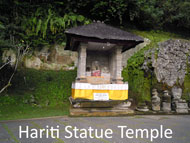
4. Hariti Statue (Men Brayut) – The Goddess and Protector of Children
Another interesting religious relic found at Goa Gajah is associated with Hariti, also known in Balinese tradition as Men Brayut.
The story of Hariti originates from Buddhist mythology. According to the traditional legend, Hariti was originally a Yakshini who was feared for taking children. Her husband was known as Pancika, and the couple had many children.
After receiving spiritual guidance from Buddha, Hariti transformed her behaviour and became a protector and guardian of children.
She eventually became associated with motherhood, fertility, family protection, and the welfare of young children.
In Bali, the story of Men Brayut is also associated with the traditional representation of a mother surrounded by many children. Her image carries an important message about family responsibilities, motherhood, and compassion.
The presence of this Buddhist-related figure at Goa Gajah demonstrates the influence of Buddhist traditions within Bali’s ancient religious landscape.
5. Buddha Statue – Dhyani Buddha Amitabha
Goa Gajah also preserves Buddhist archaeological remains, including Buddha statues associated with Dhyani Buddha Amitabha.
In Mahayana Buddhist philosophy, Amitabha is one of the five Dhyani Buddhas and is traditionally associated with the western direction and the Pure Land of Ultimate Bliss.
The statue is represented in a meditation posture, with both hands resting in the lap in the Dhyana Mudra position.
This hand gesture symbolises meditation, concentration, inner peace, and spiritual awareness.
The presence of Buddhist statues alongside Hindu religious objects is particularly significant. It illustrates how Hinduism and Buddhism coexisted and influenced one another during important periods of Bali’s history.
Other Archaeological Structures Around Goa Gajah
Beyond the main Elephant Cave and bathing pools, visitors can explore several additional archaeological remains scattered throughout the complex.
Approximately 100 metres south of the sacred bathing area are the remains of an ancient shrine or candi. Although much of the original structure has deteriorated, sections of its stone foundation and decorative carvings can still be observed.
Among the interesting remains are stone umbrella ornaments known as Chattra. One of these features 13 umbrella levels, while another has three branches. These objects are associated with traditional Buddhist symbolism and the representation of spiritual status and religious authority.
The surviving sections of the shrine also feature decorative stonework, offering an insight into the architectural skills of ancient Balinese craftsmen.
Visitors can also find two Buddha statues in the Dhyana Mudra meditation position near an ancient stone niche. The niche is part of the site’s archaeological remains and reflects the importance of meditation and spiritual retreat in earlier religious traditions.
Additional meditation niches, a resting area, and an ancient pool can be found in the surrounding grounds.
These archaeological features make Goa Gajah more than just a cave attraction. The entire complex represents an ancient religious sanctuary where Hindu and Buddhist communities practised their spiritual traditions.
The Famous Elephant Cave Entrance
The most recognisable feature of Goa Gajah is its dramatic cave entrance, carved into a rocky hillside with a large, intimidating face surrounding the doorway.
The entrance features elaborate stone carvings depicting a monstrous face, with wide-open eyes, a large mouth, and decorative motifs extending across the surrounding rock surface.
Visitors enter the cave through the mouth of the carved figure, creating the impression of stepping inside a mysterious ancient creature.
The entrance is generally interpreted as a protective or apotropaic design, intended to ward off negative forces and protect the sacred space inside.
Inside the relatively small cave, visitors can see religious shrines and archaeological objects associated with Hindu worship, including the sacred Ganesha figure and Shiva Lingga representations.
Although the cave itself is not particularly large, its unusual entrance, historical atmosphere, and religious significance make it one of the most memorable attractions in the Ubud area.
Religious and Cultural Significance of Goa Gajah
Goa Gajah is particularly important because it demonstrates the historical relationship between Hinduism and Buddhism in Bali.
Rather than representing only one religious tradition, the archaeological complex contains evidence of both Hindu and Buddhist influences. Hindu statues, Shiva-related symbols, Buddhist meditation figures, and sacred water structures can all be found within the same historical sanctuary.
This combination reflects the religious diversity and cultural development of ancient Bali.
The site also provides insight into traditional Balinese beliefs concerning purification, spiritual protection, meditation, and the relationship between humans and the divine.
Even today, Goa Gajah remains an active sacred area where religious ceremonies and offerings are part of local spiritual life. Visitors should therefore remember that this is not simply a tourist attraction but also an important place of worship.
Visiting Goa Gajah from Ubud
Goa Gajah is an excellent destination for visitors staying in Ubud who want to explore Bali’s ancient temples and archaeological heritage.
Located approximately 6 kilometres from Ubud town centre, the attraction can generally be reached in around 15–25 minutes by car, depending on traffic and your starting point.
The site is also conveniently located near several other popular attractions, making it easy to include in a full-day Ubud sightseeing itinerary.
Nearby attractions include:
-
Yeh Pulu Relief: An ancient rock-carved relief featuring historical scenes and figures, located close to Goa Gajah.
-
Tebing Tegallinggah Temple: An archaeological temple complex with ancient rock-cut shrines.
-
Pura Samuan Tiga: A historically significant Hindu temple in Bedulu.
-
Ubud Monkey Forest: A popular nature reserve and temple complex in central Ubud.
-
Pura Gunung Kawi: An ancient temple complex famous for its monumental rock-cut shrines.
-
Tirta Empul Temple: A sacred water temple famous for its traditional purification pools.
Combining these attractions provides an interesting journey through Bali’s history, traditional architecture, religious practices, and natural scenery.
Best Time to Visit Goa Gajah
The best time to explore Goa Gajah is generally in the morning, when the weather is cooler and the archaeological complex is often more comfortable to explore.
A visit usually takes around 1–2 hours, depending on how much time you spend examining the cave, bathing pools, stone carvings, and surrounding archaeological remains.
Visitors should wear comfortable walking shoes because the site includes stone steps, uneven pathways, and garden areas.
As Goa Gajah is a sacred Hindu temple, appropriate clothing is required. A sarong and sash may be necessary when entering certain temple areas, and visitors should follow the instructions of local temple staff.
Goa Gajah Entrance Fee and Opening Hours
Visiting Goa Gajah (Elephant Cave Temple) in Bedulu Village, Gianyar, Bali, requires an entrance ticket. This historical archaeological attraction welcomes both domestic and international visitors who wish to explore its ancient cave, sacred bathing pools, stone carvings, and Hindu-Buddhist religious heritage.
The entrance fee for international visitors is approximately IDR 50,000 per adult and IDR 25,000 per child aged 5–11 years. Domestic and local visitors may receive different admission rates, depending on the applicable ticket category.
Goa Gajah Entrance Ticket Prices
The following is a general guide to admission costs:
| Visitor Category | Entrance Fee |
|---|---|
| International adult | IDR 50,000 |
| International child (5–11 years) | IDR 25,000 |
| Domestic/local visitors | Around IDR 30,000 |
| Motorcycle parking | Around IDR 5,000 |
| Car parking | Around IDR 10,000 |
Please note that ticket prices and parking charges may change without prior notice. Confirm the latest rates at the entrance before visiting.
Additional Visitor Information
-
Sarong and Sash: A sarong and sash are generally provided or made available for visitors as part of the temple entrance arrangements. These traditional garments must be worn when entering designated sacred areas, as a sign of respect for Balinese Hindu customs.
-
Domestic Visitor Rates: Indonesian citizens and local visitors may qualify for a different admission price, generally around IDR 30,000, depending on the current ticket policy.
-
Parking Fees: Parking is usually charged separately and paid in cash. Motorcycles generally cost around IDR 5,000, while cars cost approximately IDR 10,000.
-
Opening Hours: Goa Gajah is generally open daily from 8:00 AM to 6:00 PM.
-
Location: Bedulu Village, Blahbatuh District, Gianyar Regency, Bali, approximately 6 kilometres southeast of Ubud town centre.
Tips for Visiting Goa Gajah
For a more comfortable sightseeing experience, consider visiting Goa Gajah in the morning when temperatures are cooler and the archaeological complex is less crowded. Allow approximately 1–2 hours to explore the famous Elephant Cave, ancient bathing pools, religious statues, and surrounding temple grounds.
Goa Gajah is an active sacred site, so visitors should dress respectfully, follow temple regulations, and maintain appropriate behaviour throughout the complex.
Photo Gallery Elephant Cave Temple




We are very happy to be lead and show the attractions you visit so that will also show places that are still unique attractions such as Balinese dance, Balinese customs, Panorama Bali and Local Handicrafts with Bali’s price is very cheap. And you can design a tour or a tour that will visit.
Don’t waste your time…
Call our 24 hours hot line (WhatsApp) at: +(62) 81-2397-7705
E-mail: info @ balibushire.com for further information. You can also reach us via Skye to discuss your travel needs and plans.