
Monday | 5th October 2026
A Russian drone struck a major bridge in the Ukrainian capital of Kyiv on Sunday as German Chancellor Friedrich Merz arrived in the city to demonstrate Germany’s support for Ukraine. The timing of the attack underscored the increasingly dangerous security environment facing the capital, with air raid sirens, explosions and the activation of Ukrainian air-defense systems heard as Merz began his visit.
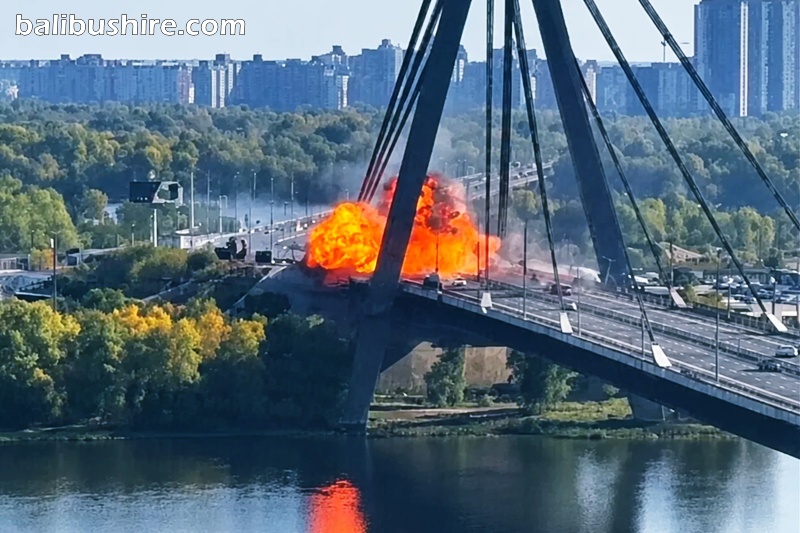
The strike hit Kyiv’s Northern Bridge, one of the key crossings over the Dnipro River that connects the eastern and western parts of the capital. Video footage circulating from Sunday morning showed a large fireball erupting on the bridge, followed by a thick column of black smoke, while vehicles were still traveling across the structure. Kyiv Mayor Vitaliy Klitschko said two people were injured in the attack.
The Northern Bridge had already been targeted shortly before the latest strike, while another major crossing, Kyiv’s Southern Bridge, was hit repeatedly in attacks earlier in the week. The repeated strikes have raised concerns about the vulnerability of Kyiv’s transport infrastructure and the possibility that Russia is seeking to disrupt movement between the two banks of the Dnipro.
Ukrainian officials have warned that attacks on the bridges could have consequences well beyond temporary traffic disruption. Kyiv is geographically divided by the Dnipro, with major government buildings, businesses and administrative institutions concentrated largely on the western bank and extensive residential districts located on the eastern side. Damage to the crossings could therefore complicate the movement of civilians, emergency services, supplies and military personnel across the city.
The Kyiv authorities have said they are preparing contingency plans, including the construction of alternative crossings over the Dnipro if the attacks continue. Such measures would be intended to maintain basic transportation links and prevent the destruction or repeated closure of individual bridges from effectively isolating parts of the capital.
Russia has acknowledged targeting the Northern Bridge. Its Defense Ministry said the structure was being used as a route for transporting troops and military equipment and therefore represented a military logistics target. Moscow also reported strikes against two dry-cargo vessels near Odesa that it claimed were carrying military equipment. Russian officials said other attacks had targeted logistics and infrastructure facilities in the wider Odesa and Kyiv regions. The claims have not all been independently verified.
Merz signals stronger German support
The attack came as Merz made an unannounced visit to Kyiv alongside German Economic Affairs and Energy Minister Katherina Reiche. The German chancellor traveled to Ukraine despite Russian warnings that foreign visitors and senior officials in the capital could face danger as Moscow intensifies its air campaign.
Merz used the visit to emphasize that Germany intends to remain a major supporter of Ukraine. He said Ukraine needed the support of its allies during what he described as decisive weeks ahead, warning that Russia’s attacks on Ukrainian towns, residential areas and energy infrastructure could eventually pose a broader security threat to Europe.
“You can rely on us,” Merz said in a message posted before his meetings in Kyiv.
The visit resulted in a new German assistance package worth more than €1.3 billion. About €1 billion is earmarked for military assistance, including long-range weapons, combat drones, satellite technology and other defense capabilities. Germany is also providing €350 million to help repair Ukraine’s damaged energy infrastructure ahead of another winter of war.
The two governments also signed a series of agreements involving German and Ukrainian companies. The agreements cover areas including air-defense equipment, radar systems, drone production and other defense technologies. Berlin is particularly interested in helping Ukraine expand its ability to detect and intercept the increasingly sophisticated drones being used by Russia.
The growing German-Ukrainian defense partnership is significant because Ukraine has been struggling to maintain sufficient stocks of air-defense interceptors while facing increasingly large waves of missiles and drones. Russia has expanded its use of jet-powered Shahed-type drones, which can travel faster than earlier versions and make interception more difficult.
Ukraine has sought additional systems and technologies capable of detecting and destroying these weapons before they reach cities and critical infrastructure. German support for drone production and air defense is therefore intended not only to provide immediate military assistance but also to expand Ukraine’s domestic capacity to defend itself over the longer term.
Kyiv faces another winter of attacks
For Kyiv’s roughly three million residents, however, the immediate concern remains whether the capital’s infrastructure can withstand another sustained Russian air campaign.
The bridges are only one part of the infrastructure under pressure. Russia has increasingly targeted energy facilities, industrial sites, logistics hubs and other infrastructure across Ukraine as the winter season approaches. Ukrainian authorities fear that repeated attacks could damage electricity generation and distribution networks, heating systems and transportation links, creating additional pressure on civilians.
The latest campaign also comes after Moscow announced that it would intensify its strikes against Ukraine.
Russia’s Defense Ministry said attacks against Ukrainian military and military-industrial facilities, as well as associated infrastructure in Kyiv and other regions, would be intensified. Moscow presented the escalation as a response to Ukrainian attacks and statements by President Volodymyr Zelensky about expanding strikes against Russian energy infrastructure.
Zelensky has said Ukraine intends to increase attacks on Russian oil refineries in response to Moscow’s expanding campaign against Ukrainian infrastructure. In an interview with Reuters, he argued that Kyiv needed to respond to attacks on Ukraine’s energy system by striking the infrastructure that provides Russia with revenue to finance the war.
“We have to respond in any way we can,” Zelensky said, while stressing that Ukrainian attacks would focus on infrastructure rather than civilians.
The strategy carries wider economic consequences. Russian oil refineries are critical to the country’s fuel supply and export system, while disruptions to refining capacity can affect international markets. President Donald Trump has urged Ukraine to avoid attacks on Russia’s oil infrastructure, arguing that such strikes contribute to higher global energy prices.
The disagreement highlights one of the increasingly complicated dimensions of the war: military decisions made on the battlefield can have consequences far beyond Ukraine and Russia, affecting fuel supplies, energy prices and economic conditions in Europe and other parts of the world.
Russia and Ukraine escalate their long-range campaigns
The latest exchange of attacks reflects a broader transformation of the war, with both sides increasingly relying on long-range drones and missiles to strike targets far from the front line.
For Russia, the campaign has increasingly focused on Ukrainian cities and infrastructure. Kyiv has been particularly vulnerable because of its political importance, population and extensive network of transportation and energy facilities.
For Ukraine, attacks deep inside Russia have increasingly focused on oil refineries, fuel facilities and other economic targets that Kyiv says contribute directly to Moscow’s ability to sustain the war.
The cycle has created a growing risk of retaliation. Russia has warned that Ukrainian attacks on its energy infrastructure will lead to further strikes inside Ukraine, while Kyiv says it will continue responding to Russian attacks rather than allow its infrastructure to be destroyed without retaliation.
At the same time, diplomatic efforts have yet to produce an immediate reduction in fighting. Zelensky has indicated that Ukraine remains prepared to participate in discussions involving Russia and the United States, while Washington has continued to explore possible diplomatic channels.
For Merz, his arrival in Kyiv during an active Russian air campaign was therefore intended as more than a symbolic gesture. It demonstrated that Germany’s political and military support for Ukraine is continuing even as the risks surrounding the conflict increase.
The German chancellor’s message was that Ukraine should not expect to face the coming months alone. But the continuing attacks on Kyiv’s bridges, energy facilities and other infrastructure demonstrate the scale of the challenge facing Ukraine as it enters another difficult winter of war.
With Russia threatening further strikes and Ukraine preparing to intensify attacks on Russian oil infrastructure, the immediate outlook remains dominated by escalation rather than a sustained reduction in hostilities.