
Friday | 17th July 2026
Beijing — While US President Donald Trump used a nationally televised address from the White House to accuse China of exploiting American election data, Chinese President Xi Jinping was presenting an entirely different vision of his country’s role in the global technology race.
Speaking at China’s flagship artificial intelligence summit in Shanghai on Friday, Xi portrayed Beijing as a responsible technological power committed to ensuring AI benefits humanity rather than threatens it. His remarks underscored China’s growing ambition not only to compete with the United States in developing cutting-edge AI systems but also to shape the international rules governing one of the world’s most transformative technologies.
The striking contrast between the two leaders’ speeches highlighted the widening strategic divide between Washington and Beijing, where artificial intelligence has become the newest and perhaps most consequential arena of geopolitical competition.
Two Very Different Narratives
Addressing hundreds of technology executives, researchers, entrepreneurs and policymakers gathered at the World Artificial Intelligence Conference (WAIC), Xi emphasized that the rapid evolution of AI demands international cooperation rather than confrontation.
“With AI advancing at a staggering speed, we must ensure its development is for positive, for good, and for humanity,” Xi said during his keynote address.
He stressed that governments must establish effective oversight mechanisms capable of preventing AI from becoming dangerous while encouraging innovation that serves society.
“We must make its oversight and governance precise and effective and constantly refine measures to forestall loss of control,” Xi added.
Only minutes later and thousands of miles away in Washington, Trump delivered a sharply different message.
The US president accused Beijing of engaging in widespread efforts to interfere in American democracy, alleging Chinese entities had illegally obtained approximately 220 million US voter records as part of broader election influence operations. China has firmly denied those accusations.
The simultaneous speeches reflected more than diplomatic disagreement—they illustrated fundamentally opposing visions of how artificial intelligence should be governed, regulated and deployed worldwide.
AI Becomes the New Front Line in US-China Rivalry
Artificial intelligence has rapidly emerged as one of the most strategically significant technologies in the global competition between the world’s two largest economies.
Beyond its commercial potential, AI carries enormous implications for national security, military capabilities, cybersecurity, economic competitiveness and political influence.
Governments increasingly recognize that whichever country establishes leadership in AI could gain lasting advantages across numerous sectors.
Against that backdrop, Xi’s speech represented a clear effort to position China as a global architect of AI governance rather than simply a technological challenger to the United States.
Chinese officials have consistently argued that AI should remain a shared international resource instead of becoming another tool of geopolitical rivalry.
Without directly naming Washington, Xi criticized efforts to broaden national security arguments to justify restrictions on AI cooperation.
He warned against “overstretching the national security concept in the field of AI” or placing “one country’s security over that of others.”
The comments were widely interpreted as an indirect critique of US export controls, technology restrictions and efforts to limit China’s access to advanced semiconductors and AI technologies.
Beijing Promotes AI as a Global Public Good
Rather than framing AI primarily as a strategic competition, China has increasingly promoted the technology as what it calls a “global public good.”
Chinese officials argue that developing countries should have equal opportunities to benefit from AI advancements and that international cooperation should remain open despite geopolitical tensions.
As part of that strategy, Beijing officially launched the World Artificial Intelligence Cooperation Organization (WAICO) ahead of the Shanghai summit.
The new organization initially includes 29 participating countries, among them Russia, Indonesia and Pakistan, reflecting China’s effort to build an alternative international platform for AI collaboration outside Western-led institutions.
The organization aims to facilitate technological cooperation, promote AI governance standards and encourage cross-border innovation among member states.
Analysts say the initiative reflects China’s broader diplomatic strategy of expanding its influence through emerging technologies.
George Chen, chair of digital practice at consulting firm The Asia Group, described the effort as a new form of diplomacy centered on artificial intelligence.
According to Chen, Xi views AI not merely as an economic opportunity but also as a geopolitical instrument capable of strengthening China’s international partnerships.
“Xi sees AI as an opportunity to get more allies to compete with the US, not just in AI technology, but also in international relations,” Chen said.
“It’s AI diplomacy.”
Learning from the Internet Era
Chinese policymakers believe their country missed an earlier opportunity to influence the rules governing the modern internet.
When the World Wide Web expanded globally during the 1990s and early 2000s, the United States and Western technology companies largely established the dominant standards, protocols and governance frameworks.
Today, however, China’s economic and technological position has changed dramatically.
With world-leading companies in artificial intelligence, robotics, telecommunications and manufacturing, Beijing believes it now has a realistic opportunity to influence how AI develops worldwide.
“Thirty or forty years ago, China was a very poor country,” Chen noted.
“But everybody knows today is different, and if AI is the new internet, China doesn’t want to miss the opportunity again.”
That ambition extends beyond technological innovation into setting international norms on ethics, safety, regulation and cross-border cooperation.
Different Strategies in the AI Race
Although American companies remain widely regarded as leaders in developing the world’s most advanced frontier AI models, China’s strategy differs significantly from Silicon Valley’s approach.
US firms such as OpenAI, Anthropic and Google continue to lead in cutting-edge model capabilities and benefit from superior semiconductor technologies used for AI training.
However, many analysts believe China’s strength lies elsewhere.
Rather than focusing exclusively on producing the most advanced large language models, Beijing is emphasizing widespread industrial deployment.
Chinese companies are aggressively integrating AI into robotics, smart manufacturing, logistics, healthcare, transportation and factory automation.
This strategy seeks to maximize productivity gains across the broader economy instead of concentrating solely on frontier research.
Experts argue that if China succeeds in embedding AI deeply into its manufacturing ecosystem, it could gain significant long-term advantages despite remaining slightly behind in top-tier model performance.
Chinese AI Companies Close the Gap
China’s leading AI developers have made rapid progress over the past year.
Companies such as DeepSeek and Zhipu have narrowed the performance gap separating Chinese models from leading American systems.
One factor driving their global adoption is cost.
Many Chinese AI models operate at substantially lower prices than comparable American offerings while also embracing open-source architectures that developers can modify and deploy more freely.
Those characteristics have attracted growing interest from businesses, researchers and software developers worldwide.
Data compiled by research platform Our World In Data illustrates the shift.
Chinese companies accounted for 20 of the 50 most-used AI models on OpenRouter in May, a platform that allows users to access numerous language models through a single interface.
At the beginning of 2025, only five Chinese models ranked among the platform’s top 50.
Most remaining leading models continue to originate from US companies, but China’s rapid gains suggest the competitive gap is shrinking.
Mutual Security Concerns Intensify
Despite ongoing technological advances, distrust between Washington and Beijing continues to deepen.
American officials have alleged that Chinese organizations are conducting large-scale efforts to extract knowledge from frontier US AI systems through a process known as model distillation.
Distillation allows smaller AI models to improve their capabilities by learning from more advanced systems, raising concerns about intellectual property protection and technological leakage.
China has rejected accusations that its companies are improperly exploiting American AI innovations.
At the same time, Beijing has raised its own cybersecurity concerns.
Earlier this month, Chinese regulators warned that Anthropic’s Claude Code programming assistant contained what they described as a potentially serious security “backdoor.”
Anthropic responded that the feature was an experimental abuse-monitoring mechanism designed to protect its platform and that the relevant functionality was unavailable within China.
The exchange reflected growing suspicion on both sides regarding software security and technological transparency.
AI Raises New National Security Risks
Artificial intelligence has become an increasingly important national security concern beyond traditional cyber espionage.
US officials worry that highly capable AI systems could eventually enable hostile governments or criminal organizations to identify software vulnerabilities more quickly and launch sophisticated cyberattacks against critical infrastructure.
Electricity grids, financial systems, transportation networks and communications infrastructure are all considered potential targets.
In response to those concerns, the White House recently announced new initiatives designed to strengthen cybersecurity protections against AI-assisted attacks.
China is also reportedly evaluating restrictions on overseas access to its own most advanced AI models, reflecting concerns that foreign competitors could benefit from Chinese technological breakthroughs.
Despite those tensions, both governments agreed during a summit between Trump and Xi in May to establish a formal dialogue focused on artificial intelligence.
Officials hope the discussions can reduce misunderstanding and establish safeguards as AI capabilities continue advancing.
China’s Bid to Shape Global AI Rules
Hosting the Shanghai summit has become an increasingly important platform for Beijing’s international AI ambitions.
This year’s conference attracted record participation, according to organizers.
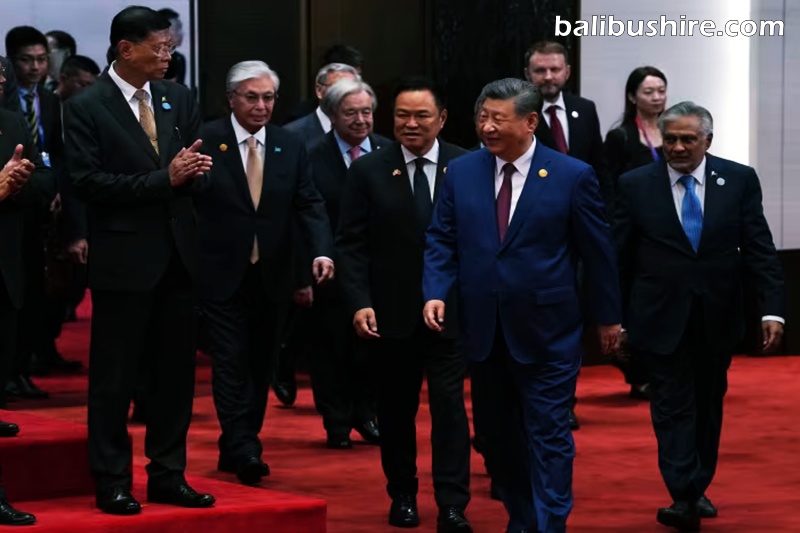
Attendees included United Nations Secretary-General António Guterres, multiple Nobel Prize recipients, winners of the prestigious Turing Award and representatives from more than 1,000 companies worldwide.
The event also carried symbolic importance.
This marked the first time Xi personally attended the conference since its launch in 2018, signaling how central AI has become to China’s long-term national strategy.
His appearance underscored Beijing’s determination to compete with Washington not only in technological innovation but also in establishing international governance standards.
Questions Over China’s Global Influence
Despite China’s expanding AI capabilities, questions remain regarding how broadly its governance vision will be accepted internationally.
Some Western analysts argue that allowing Beijing to play a leading role in shaping AI regulations could encourage the spread of governance principles reflecting China’s tightly controlled digital environment.
Critics fear those standards could prioritize state oversight, information control and surveillance over the more open internet traditions favored by many democratic countries.
There are also doubts about whether China’s newly established WAICO organization can attract significant participation beyond countries already maintaining close political relationships with Beijing.
Paul Triolo, a partner at Washington-based consultancy DGA-Albright Stonebridge Group, believes major Western governments are unlikely to join a China-led AI governance institution.
“No major Western country will likely sign on to a China-controlled organization that will likely have a broad mandate for both the promotion of AI and AI governance and safety,” Triolo said.
Instead, he argues that the most important avenue for cooperation remains direct bilateral engagement between Washington and Beijing.
“For the US, the main action will be building a credible bilateral dialogue with Beijing around frontier AI model governance,” he said.
However, achieving meaningful cooperation will be challenging.
According to Triolo, both governments face complicated bureaucratic hurdles while continuing to struggle with profound mutual distrust.
As artificial intelligence becomes increasingly central to economic growth, military capability and global influence, the rivalry between the United States and China is no longer simply about who builds the most powerful AI systems. It is increasingly about who writes the rules that will govern the technology for decades to come—and whether the world’s two largest powers can cooperate enough to prevent competition from becoming confrontation.