
Monday | 27th April 2026
The dramatic breach at the White House Correspondents’ Dinner has quickly become a flashpoint in an already tense debate over the balance between visibility, accessibility, and airtight security for America’s highest officials. What unfolded Saturday night inside the Washington Hilton — a venue long associated with both political pageantry and historic danger — is now being dissected in granular detail by investigators, security experts, and policymakers alike.
At the center of the incident is the suspect, Cole Tomas Allen, who authorities say traveled across the country with a cache of legally purchased weapons and a plan that, according to officials, may have been driven by extremist anti-government views. Acting Attorney General Todd Blanche characterized the response as a “massive security success story,” emphasizing that despite the alarming breach, the system ultimately worked: the suspect was intercepted before reaching the ballroom where Donald Trump and hundreds of high-profile guests were gathered.
Still, the fact that Allen was able to penetrate as far as he did — reportedly bypassing a checkpoint and reaching a lobby just one floor above the president — has raised uncomfortable questions. Video footage showing Secret Service agents appearing momentarily relaxed has fueled criticism that even a brief lapse in vigilance can create dangerous openings, especially in a complex, multi-level venue hosting thousands of attendees.
A Security System Under Stress
The White House Correspondents’ Dinner is unlike most protected events. It blends celebrity culture, journalism, and politics into a single high-density gathering, often with more than 2,000 attendees. That scale presents unique challenges for the United States Secret Service, which must secure not just the president, but also the vice president, Cabinet members, lawmakers, media figures, and foreign dignitaries — all within a semi-public, hotel environment.
In this case, investigators believe Allen exploited one of the event’s inherent vulnerabilities: its layered but not fully sealed security perimeter. As a registered hotel guest, he was already inside what officials describe as the “outer security bubble,” reducing the number of checkpoints he needed to pass through. Unlike events such as the UN General Assembly, where every ব্যক্তি and bag is screened before entering the building, the correspondents’ dinner typically relies on targeted screening closer to the main ballroom.
That distinction is now under scrutiny.
A federal law enforcement official noted that the suspect should have been intercepted before reaching the interior lobby space, suggesting that the transition zone between public hotel areas and secured event zones may need to be hardened. Others, however, caution against oversimplifying the situation. Former Secret Service agent Jonathan Wackrow pointed out that agents must make split-second decisions in a chaotic environment, where the presence of other officers, bystanders, and unclear lines of fire complicate any immediate response.
“You’re not operating in a vacuum,” Wackrow said. “There’s a reason discipline matters — you can’t just fire indiscriminately in a crowded hotel.”
Inside the Response
According to officials, once the threat was identified, the response unfolded largely according to protocol. Trump’s protective detail quickly moved to shield him, while additional agents took elevated positions to monitor potential secondary threats — a critical step in modern protective operations, where lone attackers are often a primary concern but not the only one.
The suspect reportedly fired at least one shotgun round during the incident, striking a Secret Service officer’s protective vest. Agents returned fire, and within moments, Allen was subdued in a lobby area near a stairwell that could have given him direct access to the ballroom below.
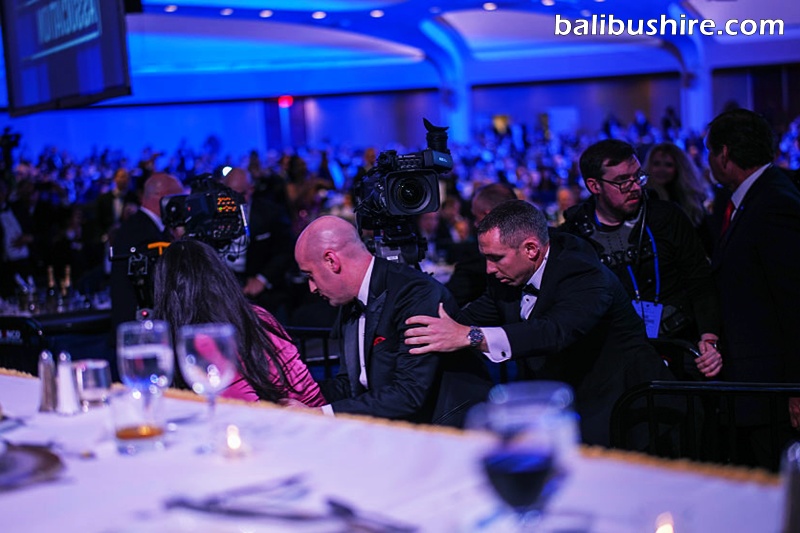
Images from the scene show a rapid containment effort: the suspect on the ground, heavily armed agents securing the area, and guests being quietly but swiftly evacuated. Among those escorted out were not only Cabinet officials but also high-profile attendees, including individuals who may themselves have been potential targets.
A Pattern of Threats
The घटना comes against the backdrop of heightened concern over political violence in the United States. Authorities have pointed to at least two prior assassination attempts targeting Trump in 2024 — one in Butler, Pennsylvania, and another at a golf course in West Palm Beach — as evidence of a persistent threat environment.
This pattern is influencing how officials interpret Saturday’s события. Investigators say Allen’s writings, which included anti-Trump rhetoric, are being closely analyzed to determine motive, intent, and whether he acted alone or was influenced by broader ideological currents.
Notably, his lack of a criminal record meant he did not appear in federal threat databases, underscoring a recurring challenge for law enforcement: individuals who radicalize or plan attacks without prior contact with authorities often evade traditional detection methods.
Rethinking the Rules
In the aftermath, internal discussions are already underway about potential changes to how events like the correspondents’ dinner are secured. One key вопрос is whether it is prudent for so many senior officials — including both the president and vice president — to attend the same large-scale event outside the White House complex.
JD Vance was present at this year’s dinner, a decision that reportedly came together late in the planning process. Some within the Secret Service have historically expressed concern about such scenarios, preferring to limit the simultaneous exposure of top leadership.
Other possible adjustments being considered include expanding pre-event screening protocols, tightening access for hotel guests, and increasing surveillance coverage in transitional areas like lobbies and corridors.
Lessons Without Illusions
Despite the тревога surrounding the breach, many officials echo Blanche’s core message: the system did not fail completely. The suspect was stopped before reaching his apparent target, and the president was not harmed.
But in the world of protective security, near-misses are treated as warnings, not victories.
As one official put it, the goal is not just to respond effectively — it is to prevent the need for a response at all. And in that sense, Saturday night’s घटना serves as a stark reminder that even the most sophisticated security apparatus must continuously adapt to evolving threats, human unpredictability, and the inherent risks of public life at the highest levels of power.